Monday, August 15, 2011

Dixie Noir: An Interactive Tourism Novel


Red, a fictional character from Dixie Noir, reads the novel in one of the real settings of the book:
the Scott and Zelda Fitzgerald Museum
 
Excerpt from: Dixie Noir by Kirk Curnutt
Tourism attractions: Scott and Zelda Fitzgerald Museum, El Rey Lounge
Location: Montgomery, Alabama
Photos: Diane Prothro. Click to enlarge any photo.
Model: Audria Carr

One of the most fun aspects of working with tourism fiction is experiencing my favorite books coming to life—not just in my imagination but literally right before my eyes. So far, it’s just been the places and the unique spirit that surrounds each one. But profiling Kirk Curnutt’s novel Dixie Noir was the first time that a character from a novel has come to life.

The character’s name is "Red," a spunky fictional waitress from the real El Rey Burrito Lounge in Montgomery, Alabama. Red has an apartment in the real Fitzgerald Museum in Montgomery, which does have both private apartments and a museum dedicated to the famous couple. As part of the photo shoot for this profile, we had a real waitress from El Rey, Audria Carr, pose as Red inside the museum, one of the main settings in the novel.

As soon as she came through the door, it was like seeing Red walk right out from the pages of the novel and into the real world. Red was certainly one of the characters that made Dixie Noir a memorable read, so please enjoy this short excerpt that captures her spirit below.

Dixie Noir is the only other interactive tourism novel I've profiled on SELTI. The first was Blind Fate. Both novels have interactive tourism guides inside the Kindle editions. These embedded tourism links take readers directly to the websites of the real settings in the books--all with one click from inside the novel. After the excerpt, learn how to visit the real places in this novel through SELTI's companion online Tourism Guide. This guide will show you how to visit real places in the novel, including the El Rey Lounge and Fitzgerald Museum—and of course how order the book!

From Dixie Noir . . .


Red reads Dixie Noir from the lawn of the Fitzgerald House in Montgomery
I managed to keep it clean until my shift ended at eleven. It had been a twelve-hour workday, but there was no way I was going to be too tired to walk Red to the Fitzgerald house. As I clocked out, I took two shots of Jägermeister. Bubba agreed to deduct them from my paycheck since I was light on cash. Then I reminded Wookie to bring his scrapbooks the next day.

As Red and I walked up Boultier, I enjoyed the night smell of jasmine and crepe myrtle. Every few paces she brushed into me, and I would revel in a whiff of something even more powerful—her. I wanted like hell to put my arm around her and pull her close, but I was afraid to.

Twice while we worked I had caught her on her cell phone looking flustered. Even with the phone’s ringer turned off, Eric the ex wasn’t going away anytime soon. The first thing I noticed when we walked into her apartment was a sheet thrown over the mirror.

“I didn’t want you worrying about seeing your own kisser,” she said with a grin. “You’re not quite the Elephant Man, but I understand. Honestly, it’s kind of a relief. Eric couldn’t take two steps without stopping to admire his own reflection.”


Red reads from the roof of her apartment at the Fitzgerald House
On her roof she spread out a down comforter and we stretched across the shingles, a few inches of safety between us. The shingles were still hot, but I didn’t care. Especially not when Red cracked her copy of Save Me the Waltz open and started reading from another tipped-in half-sheet of stationary.

“Along the staircases of dark streets, men wandered in search of girls, searching with nothing to navigate them but tenuous wisps of jasmine that taunted them with their ephemeral tracings . . . The men peeked for them behind boxwoods and while tiptoeing through unbroken and untrammeled beds of corydalis and cowslip, never thinking that these sad, playful sprites of femininity know that a man’s craving is incommensurate with his nurturing and that therefore a woman’s best option is to remain a corona of his desire . . .

“So the men were doomed to shadow the future of their own failure, wanting but incapable of truly having because truly having is truly giving, never realizing that the susurrations that said to them ‘If you can only find you are free to take’ mocked them with the lure of appetence . . . .”

That did it for me. I rolled over onto Red and kissed her, hard. I don’t think she was expecting it. At first she wedged the book against my shoulder and started to push me away. Only it didn’t seem like she really wanted me to stop, so I didn’t.
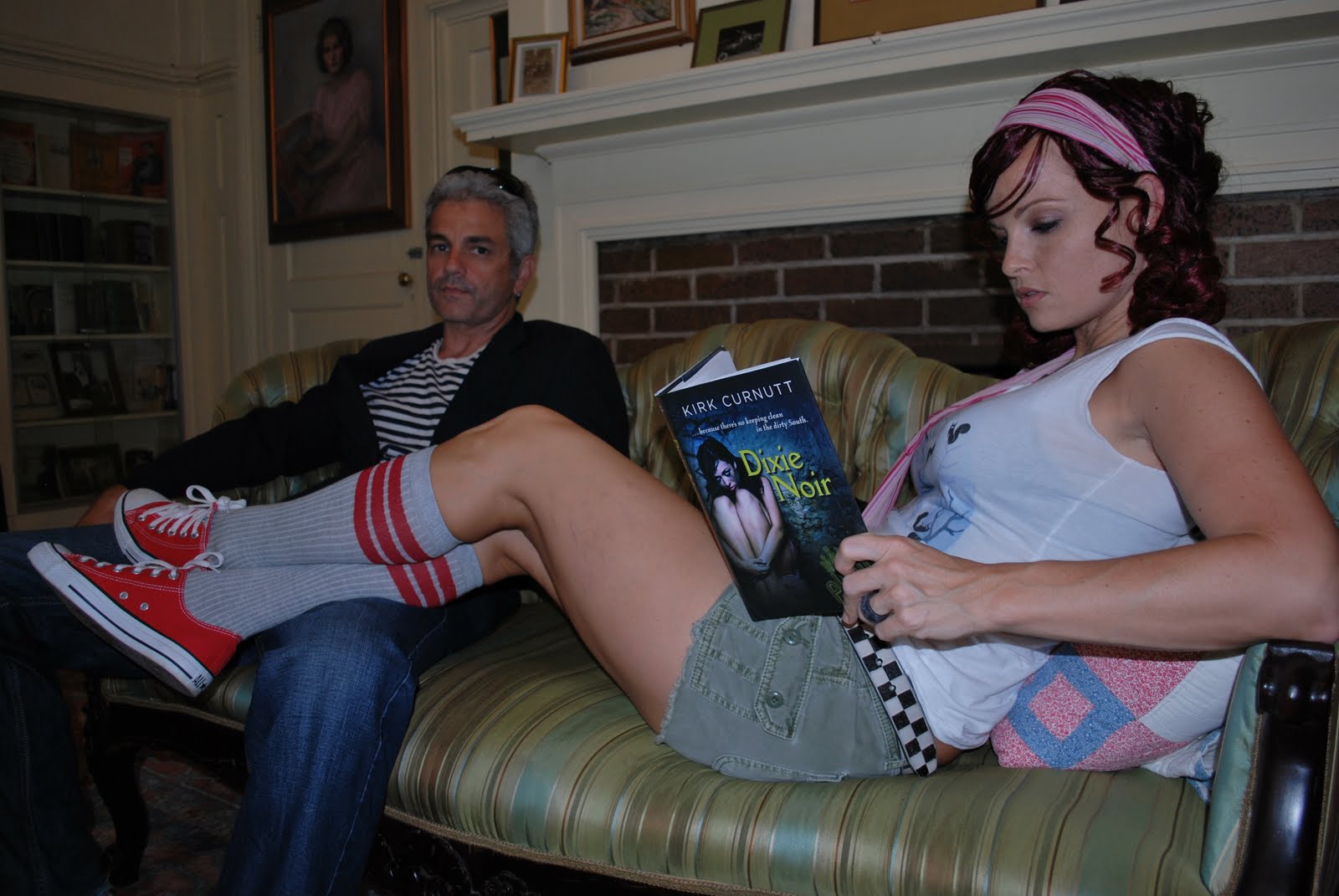
Inside the Fitzgerald Museum, Dixie Noir author Kirk Curnutt meets
"Red,"a fictional character from his novel who steps into the real world.


Then a crazy thing happened. She tucked an arm around the back of my neck and instead of pushing she pulled my mouth to hers. I felt my tongue in her mouth and hers in mine. Then she did this wild thing with her teeth. She sunk them lightly into the thick part of my tongue, the back part, and slid them down the length of it. Over and over again. Her mouth closed tightly around my tongue, and she just kept going back and forth until I thought the electric tickle the move gave off would blow out my whole circuitry.


Goddamn she tasted good.

Just as suddenly she stopped. She put her hand over my mouth and whispered, her voice a feather in the heat.

“You understand I can’t go any farther than this tonight, don’t you? You understand why, too, right?”

Sure, I understood. Why wouldn’t I? I was an ex-con. She had an ex-boyfriend. One more X in the equation and this game of ours was over. I rolled onto my back, staring at the sequined stars.

“I just broke my cardinal rule,” I confessed. “I waited ten years to practice it: ‘Do No Bad.’ I’m sorry I pressured you, Red. St. Dominic needs to get on the case to make me a better choirboy.”

Red stands on the porch of the Fitzgerald House
She propped herself on her side, above me, so her hair hung down onto my throat.

“Don’t be too good of a choirboy, Hardboil. Just remember: you’ve got to sin to get saved.”

“You smell so damn good. You know what you smell like? You smell like freedom.”

“Dominic and that other saint of yours—Jude—they’re looking out for our best interests, aren’t they?”

“If they’re not, they’re out of a job. Bubba isn’t the only one who can fire someo—”

I didn’t finish because she had pressed the curve of her neck into my face just as she had at El Rey the day before. If I didn’t have a single more minute to live, I wouldn’t have cared. I would have died a happy bastard.

---Excerpted from DIXIE NOIR, Copyright © 2009 by Kirk Curnutt, All Rights Reserved

Tourism Guide
Pull up the menu of the real El Rey from inside
the Kindle tourism edition of Dixie Noir.

Dixie Noir is the first novel profiled on SELTI other than Blind Fate with an interactive tourism link in the Kindle edition. This means that readers can, from the Kindle edition, click on links from inside the novel and visit the websites of the real places. One could, for example, pull up the menu of the real El Rey Lounge from the Kindle book or find out hours of operation directly from the Fitzgerald Museum website. It’s much easier to get this information instantly from the novel than having to go do web searches later on.

Keep in mind that Kindle novels can be downloaded to regular laptop or desktop computers, smart phones, iPads, and other devices besides the Kindle reader itself. Just go to Amazon to download the necessary software and start reading in a couple of minutes.

Some of the most intriguing places to set a novel happen to be operated by nonprofits with very limited marketing budgets, so interactive tourism novels are a great way for writers to promote the places they love and want to share with their readers. Kirk is on the board of the real Scott and Zelda Fitzgerald Museum and often frequents the real El Rey lounge.

The Fitzgerald Museum offers rare collections of books, letters, and paintings from the famous couple. For example, there is a letter from Fitzgerald to Hemingway, letters he wrote to his daughter Scottie, and letters from Zelda to Fitzgerald.

The following is from an article Kirk wrote and provided to me about Dixie Noir and its inspirations:

“The essence of Montgomery, Alabama—my home since 1993—is dialectical. Downtown, the house where Jefferson Davis oversaw Southern secession in February 1861 stands only paces from the church where Martin Luther King, Jr. directed the bus boycott ninety-five years later. The two attractions form the heart of our tourism, yet they exist in uneasy alliance, one preserving the very legacy of the Civil War that the Civil Rights Movement vowed to overcome. For every Rosa Parks we revere here, we’re urged to acknowledge (if not celebrate) Confederate valor, to appreciate states rights as intently as civic disobedience. The schism even cleaves our popular culture: Nat King Cole is our native son, Zelda Fitzgerald our wild child.”
Another hot interactive tourism novel
set in Montgomery: read an excerpt
of Blind Fate by clicking the link in
the Tourism Guide below.

Kirk and I both wrote novels inspired by modern Montgomery. My novel, Blind Fate, is told from the perspective of a blind person and covers many of the same settings as Dixie Noir, which made Kirk’s novel an especially intriguing read for me. A southern city is not a usual place for setting a noir novel, which caught my attention when first reading about Dixie Noir. Kirk did a wonderful job at every level, from places to characterization.

Kirk Curnutt and the real "Bubba"
from the El Rey Lounge at a
Dixie Noir booksigning.
A special thanks to Audria for bringing Red to life in the Fitzgerald Museum and to Diane, Kirk’s fiance, for her artistic and daring eye in taking the shots (some of which were on the roof!). Stay on the lookout for a sequel to Dixie Noir as the story switches over to Bubba’s storied life as a bartender and bouncer.

Tourism Links

Start reading the rest of Dixie Noir right now on your Kindle, iPad, iPhone, smart phone, or computer (also available in hardback): http://www.amazon.com/Dixie-Noir-ebook/dp/B003RWSASW/ref=sr_1_2?ie=UTF8&qid=1306505107&sr=8-2

Learn about all of Kirk Curnutt’s books at his official website: http://www.kirkcurnutt.com/

Scott and Zelda Fitzgerald Museum http://www.fitzgeraldmuseum.net/

Stop by for drinks and food at the real El Rey Burrito Lounge in Old Cloverdale, Montgomery’s boho district http://burritolounge.com/

Another interactive tourism novel about Montgomery, told from the voice of a young blind woman who turns out to be far more resourceful than her captor ever imagined: Blind Fate, a suspense/thriller mystery: http://southeasternliterarytourisminitiative.blogspot.com/2010/09/tourism-mystery-kindles-romance-in.html

Learn about all that Montgomery has to offer: http://visitingmontgomery.com/

Monday, June 6, 2011

Mentone: Musical Mountain Spring

Little River Canyon: All Photos Courtesy of Dekalb County Tourist Association. Click some photos to enlarge!
Excerpt from: Alabama Troubadour by Karren Pell
Tourism Attraction: Lookout Mountain
Location: Dekalb County, Alabama
Photos: Courtesy of Dekalb County Tourist Association

Writers always lend their unique perspective of the places they cover. Rarely have I appreciated a writer’s perspective more than Karren Pell’s in her book of essays, Alabama Troubadour. Her book covers eleven unique places to visit in Alabama. I had already visited over half of these places, but Karren’s particular perspective of them offered something new, beautiful, and deep (even the Coon Dog Cemetery!). I want to share a bit of her writing from the book below about one of my favorite places to visit: the mountains.

From Alabama Troubadour . . .

I have always loved the mountains. Up there my lungs fill with crisp air and my body breathes easy. My feet enjoy putting on hiking boots and tromping along trails—especially ones that lead to overlooks where my eyes follow hills that roll like a misty sea until they merge with the horizon. My shoulders feel like a load is lifted and my mind rests.

I like to stand on the edge of an overlook (but not too close to the edge) and pretend that I am the girl on the mountaintop in that famous Maxfield Parrish painting. You know the one: cobalt sky with alabaster pillow clouds that frame those azure peaks specked with tangerine—the girl’s hair and garments flow out from her body with ease and grace. She is healthy, free, and connected to the peace of nature.

So one morning, I left the “To Do” list on my desk, let two deadlines slip past, put a message on my answering machine that I was taking a break, and headed for the mountain village of Mentone . . .

The Desoto Falls and over five thousand interior acres of Lookout Mountain became Desoto State Park. The Civilian Conservation Corps developed the park and built a lodge. The creation of Desoto State Park, along with Little River Canyon National Park, has doubtless been a major factor in the preservation of the wild and beautiful land of Lookout Mountain, as well as the preservation of Mentone.
Desoto Falls

The view of Old Hotel Square is a romantic, rustic, and welcome sight in comparison to the strip malls and chain motels common in the modern era. One corner of the Square is occupied by The Hitching Post, a rustic, wooden building whose beginning dates from 1900. The Hitching Post was so named by its owners because in the forties an early breakfast was served for fox hunters staying at the hotel.

Today, it beckons visitors to browse among an eclectic collection of shops that offer crafts, antiques, and original pottery. Across the street and up a few wooden steps, a series of weathered buildings stands on higher ground and comprises the next corner of Old Hotel Square. The collection includes the Moonlight Bistro and another assortment of shops.

Up on the ridge, the renovated Mentone Springs Hotel remains the focal point of the Square. The inn’s Victorian architecture combined with modern accommodations is reminiscent of an earlier, elegant time and continues to attract guests. The grand, beautiful, and romantic Mentone Springs Hotel contrasts congenially with the homey arts and craft-style Mentone Inn across the street.
Mentone Springs Hotel

The Mentone Inn sits back from the road, framed by a low rock ledge. A wide, wraparound porch, complete with rocking chairs, sends an irresistible invitation to “set a spell.”

I followed the land that sloped gently and ended at the rock ledge. I looked out upon the sky that stretched beyond where human eyesight can peer; there was no need to look farther. The trees murmured as a mountain breeze whispered in their leaves; there was no need to hear more. Deadlines and due dates faded as my attention was drawn to a hawk circling overhead; there was nothing more important.

Below, the landscape was painted in seasonal colors, and one part blended and contributed to the whole. For—regardless of the reality I had left below—from that vantage point it became obvious there was peace in the valley.

---Excerpted with permission from ALABAMA TROUBADOUR by Karren Pell. ©2003 Karren Pell. All rights reserved.

Tourism Guide

Mentone and Lookout Mountain are definitely places geared towards a retreat, not just physical but spiritual. The lodgings range from rustic to elegant, depending on your choice. Rustic is always my favorite. The views are stunning, and the air is filled with the scent of peace. Mentone was once a high-end resort for those who sought healing from the mineral springs that made the area famous, but fortunately the tourism industry there never got overly-commercial. Follow the links below to learn more about visiting the area.

Tourism Links

Visit Lookout Mountain: take a virtual tour and request a visitor’s guide
Discover Lookout Mountain

Mentone
Mentone Springs Hotel
Order Alabama Troubadour
Learn more about Karren Pell
Lookout Mountain on Facebook: Lots of photos and videos

Tuesday, May 17, 2011

Southern Literary Trail: A National Road to Recovery?

High school students read from Fitzgerald's classic
works outside the Scott and Zelda Fitzgerald
Museum in Montgomery, Alabama.
Photo by Patrick Miller
Tourism Attractions: multiple literary sites from classic authors
Locations: Mississippi, Alabama, Georgia
Photos: provided by the Southern Literary Trail, unless otherwise credited


“THE SOUTHERN LITERARY TRAIL connects southern places in Alabama, Georgia and Mississippi that inspired great American writers to create classic fiction and plays. The inspiration continues. Every two years, the Trail's organizers host Trailfest, the only tri-state literary festival in the United States with free events, theatrical performances and heritage tours.”
---From the Southern Literary Trail website

The Southern Literary Trail uses a central website to connect all these places and events, providing a convenient gateway for readers to browse through all the tourism opportunities. The website includes links to individual museums and attractions along with updated schedules for events. The following is my dialogue with the Trail’s founder, William Gantt. Visit the Southern Literary Trail by clicking this link: Southern Literary Trail.

Interview with William Gantt, Founder of the Trail

Rowan Oak, the home of Faulkner
in Mississippi, one of the
attractions on the Southern Literary Trail.


Patrick Miller: One of the most interesting aspects of the Southern Literary Trail is its multi-state organization. Instead of each tourism attraction working independently to promote itself, all the attractions benefit from a central website. For example, I started looking at the trail when researching Monroeville’s tourism connection to Harper Lee, but suddenly I was clicking on links and reading about the Scott and Zelda Fitzgerald Museum in Montgomery, Faulkner’s house in Mississippi, and other literary tourism attractions in Georgia. I wouldn’t have known about those other places without a central website connecting them all with easy links, for example this link to the Scott and Zelda Fitzgerald Museum.

Did the partner attractions experience a marked increase in tourism after joining the Southern Literary Trail? If so, has that increase accelerated over time? For example, a Monroeville resident told me that the Monroe County Courthouse and Museum used to be visited by individual carloads of tourists, but now long lines of buses are arriving every year for the events.

William Gantt: Yes. Our partner sites have reported increases in both visitation numbers and general exposure by their participation in the Southern Literary Trail. For example, the Carson McCullers Center was contacted by a McCullers fan in Japan who discovered the Center on our website. This fan has attended two events in Columbus, Georgia, dedicated to Carson McCullers since her discovery of the Trail. Many of our sites report visits by guests who are using the Trail map as their guide for literary tourism through the three member states. Some of these visitors have been from Europe.

Miller: Whenever literary tourists visit attractions on the Southern Literary Trail like Monroeville or the Fitzgerald Museum, they are likely to be staying in local hotels, eating in local restaurants, and shopping in local stores during their visit. All of this economic activity is great in good times, but now that the economy is on the verge of collapse, are such tourism attractions becoming vital rather than just beneficial to local economies?

Food for thought: Literary tourists
also spend money in local restaurants!
For example, the Congress is currently debating raising the nation’s debt ceiling because the country can no longer afford to pay its debts due to lackluster economic activity. What would be the impact if the federal government launched a national literary trail based on your model? Would such a national trail help boost tax revenues and create jobs across the nation? Based on your experience with the operating costs of the Southern Literary Trail, would establishing a federal trail be cost prohibitive right now or a wise investment involving minimal taxpayer dollars with a much higher return in tax revenues?

Gantt: Trail attractions and programs definitely bring tourists into their towns. It goes without saying that tourists want lodging and good local food. I think any collaboration is beneficial, and it certainly maximizes the expenditures of public funds when multi-state partnerships are created for investments in collective promotion and mutual programs.

Miller: If the federal government did establish a national literary trail, how important would it be to use the Southern Literary Trail as a model? Are there any mistakes or pitfalls that you would warn them to avoid based on your experience? Would you want to merge into such a national trail, remain completely independent of it, or establish a regional autonomy within a national publicity platform (i.e., each national region would run its own trail, but all would be highlighted and publicized on the national trail).

Andalusia Farm in Georgia.

Gantt: I think our Trail serves as a model for anyone who seeks to cross state lines for creative or artistic purposes. You must realize that individual partners do not want to surrender or give up their own personalities in the process. So, you must avoid the mistake of seeking collaboration at the cost of individuality. Every literary museum takes on the personality of its particular writer. Naturally a house museum such as the Welty House, the Fitzgerald House Museum, Rowan Oak or Andalusia Farm will reflect the personality of its occupant. That’s what you want. Visitors go to Rowan Oak to see how Faulkner lived. Consequently, a partnership must seek to celebrate the differences and individuality of each partner. It is a common mistake for collaborative projects to seek “common ground.” The Trail merges some amazing and unique writers through the “common ground” of great 20th Century American fiction and a theme of place as influential on writing. Beyond those shared traits, we seek to celebrate the differences and diversity of our writers.

Miller: The Europeans have a well-organized, lucrative literary tourism industry, but America seems to lag far behind in this market, except for the Southern Literary Trail. Is there something unique about the South that produced our nation’s first multi-state organized literary trail? Why do you think the rest of the country hasn’t caught on to the idea yet?

Gantt: I am pleased to say the Southern Literary Trail is the nation’s only tri-state literary trail. In the South, we are storytellers, and we appreciate great stories. Perhaps Europeans have a similar storytelling culture. I hope that our success indicates the rest of the nation is ready for this concept that we have pioneered.

Update: Jan. 2012, F. Scott Fitzgerald's This Side of
Paradise: Interactive Tourism Edition
released
with links to the Southern Literary Trail (seen above)
inside the book. Available as exclusive Kindle edition. 

Miller: New technologies like the Kindle are creating vast yet largely untapped opportunities for promoting tourism. For example, Kindle novels can include live, clickable links inside the text that allow readers to jump instantly to related websites like the Southern Literary Trail. As more readers convert to reading books on Kindles and iPads (which also support Kindle novels), what are the possibilities of putting a direct link to the Southern Literary Trail in all of the trail’s books?

Would such links dramatically increase tourism to the trail’s attractions? For example, what if every Kindle edition of The Great Gatsby included a direct link to the Fitzgerald Museum’s page on the Southern Literary Trail in Montgomery? Or perhaps every Kindle edition of To Kill A Mockingbird included a Southern Literary Trail link to Monroeville? Millions of people will continue to read these classic novels for generations, but many don’t know about the literary tourism sites or events related to the books. Would you consider partnering with the publishers to advise them in producing Tourism Editions of these classic books?

Gantt: Of course. We are looking for any partnership that will promote reading of classic Southern fiction, which is also the best American writing in my opinion. I still buy books that consist of paper and bound covers, but we certainly have organizers and participants in the Trail who could assist in connecting and linking with newer technologies.

Miller: Have you ever considered including contemporary authors on the Southern Literary Trail? I know that such an inclusion would require a high standard of literary merit, not just high sales numbers. However, how would one identify modern novels that will one day become literary classics?

For example, take Alabama author Watt Key’s debut novel Alabama Moon from 2006:
A classic novel for the 21st century?

• Sold over 100,000 copies
• Published by a major New York house
• Made into a movie starring John Goodman
• Translated into several languages
• Already being taught in schools
• Has a classic theme on the importance of human relationships
• Set in the real Talladega National Forest of Alabama
Today's Tom Sawyer: Camping Under An Alabama Moon

Gantt: The Trail’s bylaws require our honored writers to be authors of classic 20th Century fiction that can be readily identified with particular places. Contemporary writers are not candidates for the Trail in the foreseeable future. But, we do honor current writers in our programs and celebrations, notably current writers who are clearly influenced by a sense of place. The Trail structure does provide us with a great tentpole to celebrate contemporary fiction writers within these themes. Our bylaws do not include writers of non-fiction.
Can contemporary tourism novels use mystery,
suspense, and romance to boost
tourism across the nation? Blind Fate
is the first tourism novel to use links
inside the story to allow readers to
visit the websites of the real settings.

Miller: If the goal of a national literary tourism trail would be to spur economic activity and get this nation back to prosperity, would it be wise to include genre novels in separate categories such as romance, mystery, and suspense? I know that such novels would not (and should not) be included on the Southern Literary Trail. However, consider all of the women in the nation who are addicted to romance novels. Who has ever invited them all to visit one place, the real setting of a novel? These types of novels might not rise to the level of Fitzgerald in literary merit, but millions of readers do consume them with a voracious appetite. What would happen if those novels were geared towards tourism like the books on the Southern Literary Trail? Could the tourism organizational tools of the Southern Literary Trail be used as a model for non-classic but popular works of contemporary fiction? Could tourism fiction become a hot new genre?
Blind Fate: a modern tourism suspense novel.

Gantt: I think any collaborative effort to support the literary arts and literary tourism is a good idea! I do not foresee the Trail as a project that will ever attempt to create genre categories for the writing we celebrate.

The reading room in the Fitzgerald Museum offers
scholars, students, and literary tourists a wealth
of material to connect with the classic author
on a much deeper level.
Miller: Speaking of Fitzgerald and romance, how many modern readers do you think are aware of just how romantic he was? Is there some way of reintroducing him to modern readers as the ultimate standard in romance? What can modern authors learn from his concepts of romance, of those precious moments that bloom in the early part of a courtship? Do you think modern romance readers would not respond to his work or have they simply never been exposed to his elevated sense of love, where every motion and inflection of a beautiful woman can conquer a man’s heart?

Gantt: All a modern reader needs for an introduction to Fitzgerald’s complex views of romance and love is “The Ice Palace,” a short story about his romance with Zelda and inspired by Montgomery. The Alabama Readers Theatre just performed it in several of our Trailfest 2011 programs and it mesmerized our audiences. Any reader will get hooked on Fitzgerald and his notions of romance with “The Ice Palace.” Hopefully one story or novel leads to another after the initial introduction has been made.
The first classic novel in the world with an
interactive tourism guide, now available at Amazon. 

Editor's Note: For a great excerpt from an article written by Fitzgerald on the inspiration of “The Ice Palace,” visit this link: "The Ice Palace" Fitzgerald's southern inspiration.

Miller: In today’s society, most of us are extremely distracted by a variety of entertainments, from Facebook, to smart phone apps, to hundreds of satellite and cable channels. I enjoy reading classic works because they were written before such distractions seemed to take over our national attention span. Reading a classic novel is almost a relaxing step into a time that was more focused and meaningful. Is it more difficult to market something like the Southern Literary Trail in such a fragmented society or have you found that modern tools like the Internet help?

Gantt: The internet absolutely made the Trail possible. This project would not have existed without the internet. Most of our communications between Trail partners and organizers are conducted electronically or via social networks.

Miller: What are the plans for the Southern Literary Trail to expand into other Southern states? For example, there is Hemingway’s home in Key West: http://www.hemingwayhome.com/.

Gantt: At the moment, we are building our project within the three original member states. Our Trail board voted not to add any more states for the next two years, at least.
Large crowds of tourists at the Monroe
County Courthouse and Museum in
Monroeville, AL, hometown and
inspiration for Harper Lee's classic
novel To Kill A Mockingbird.
Photo by Peggy Collins,
Alabama Department of Tourism 

Miller: The Southern Literary Trail is an emerging economic engine in the states hardest hit by the recent tornadoes and the after-effects of the Gulf Oil Spill. What role could the federal government play in helping to boost our tourism as a way of paving our road to recovery?

For example, what would be the impact if President Obama gave a national speech highlighting the Southern Literary Trail from the beautiful grounds of the Fitzgerald House (which served as the first meeting place of the Southern Literary Trail’s organizers)? Such a speech might include an invitation for other states and regions of the country to adopt the same model of literary tourism to be promoted on a national website. Alabama was already hard-pressed to meet its budgetary goals before these tragic events, but increased state tourism revenues can help the overall recovery effort in areas that need it the most right now. How critical are tourism revenues to the state budget and would such national publicity be worth even more (in potential tourism revenues and jobs) than FEMA grants?

Gantt: We would welcome a speech by the President or any national leader that highlights the Trail and encourages visitors to discover us! I must remind you that we are not just a tourism project. Many of our partner sites actually are dedicated to scholarship efforts, such as providing homes to writers and artists in residence. While we encourage literary tourism, I would hope that some national recognition might be paid our sites for their promotion of literary scholarship. For example, the Lillian Smith Center in Clayton, Georgia, has an artist in residence program every summer. It is not generally opened for tourism, but it still does very important work for the promotion of both classic and contemporary Southern Literature. The McCullers Center can be toured by appointment, but its daily mission is research and scholarship.

The interior of the Monroe County Courthouse
during a reenactment of the trial in
To Kill A Mockingbird. Photo by Peggy
Collins, Alabama Department of Tourism.

Miller: Generations of readers have not only been entertained but enriched as human beings by classic novels. Many of the travelers on the Southern Literary Trail have read the books long before, but what is their experience when stepping into the many attractions on the trail? How does visiting the physical places add to the experience of reading the book? For example, what is it like for fans of Harper Lee’s To Kill A Mockingbird to step into the real courtroom that inspired her famous trial with Atticus Finch?

For pictures of Monroeville and the courthouse, click here: Hollywood Visits Monroeville.

Gantt: As I stated, the influence of place upon Southern fiction is one of the themes of the Trail. For a reader to step into the settings that influenced one of his or her favorite novels can be as life-affecting as reading the book itself. We make these experiences possible along our Trail. I am grateful to this blog and so many others for helping us to create and promote this journey for readers.